
Only someone who has held a violin knows the special place it holds in your heart. That’s exactly why choosing the right one matters so much, and today I want to walk you through everything I wish someone had told me before I picked mine.
Whether you’re buying your very first violin for yourself or for your child, here’s my step-by-step guide to getting it right.
1. The size of your Violin
This is the first step, and perhaps the most important one. It’s simple: the size of the violin depends on the size of the person who will play it.
It’s essential to have a violin that fits your body, this is especially true for children, most of whom will need to change sizes fairly often as they grow. Sizing depends on physical characteristics, not age. The standard adult size is 4/4; anything larger than that becomes a viola. If you feel too big for the violin, it may be worth considering the viola instead, a wonderful instrument that sounds just as beautiful, if not more so.
Violin sizes are organized in fractions: 1/32, 1/16, 1/8, 1/4, 1/2, 3/4, and 4/4.
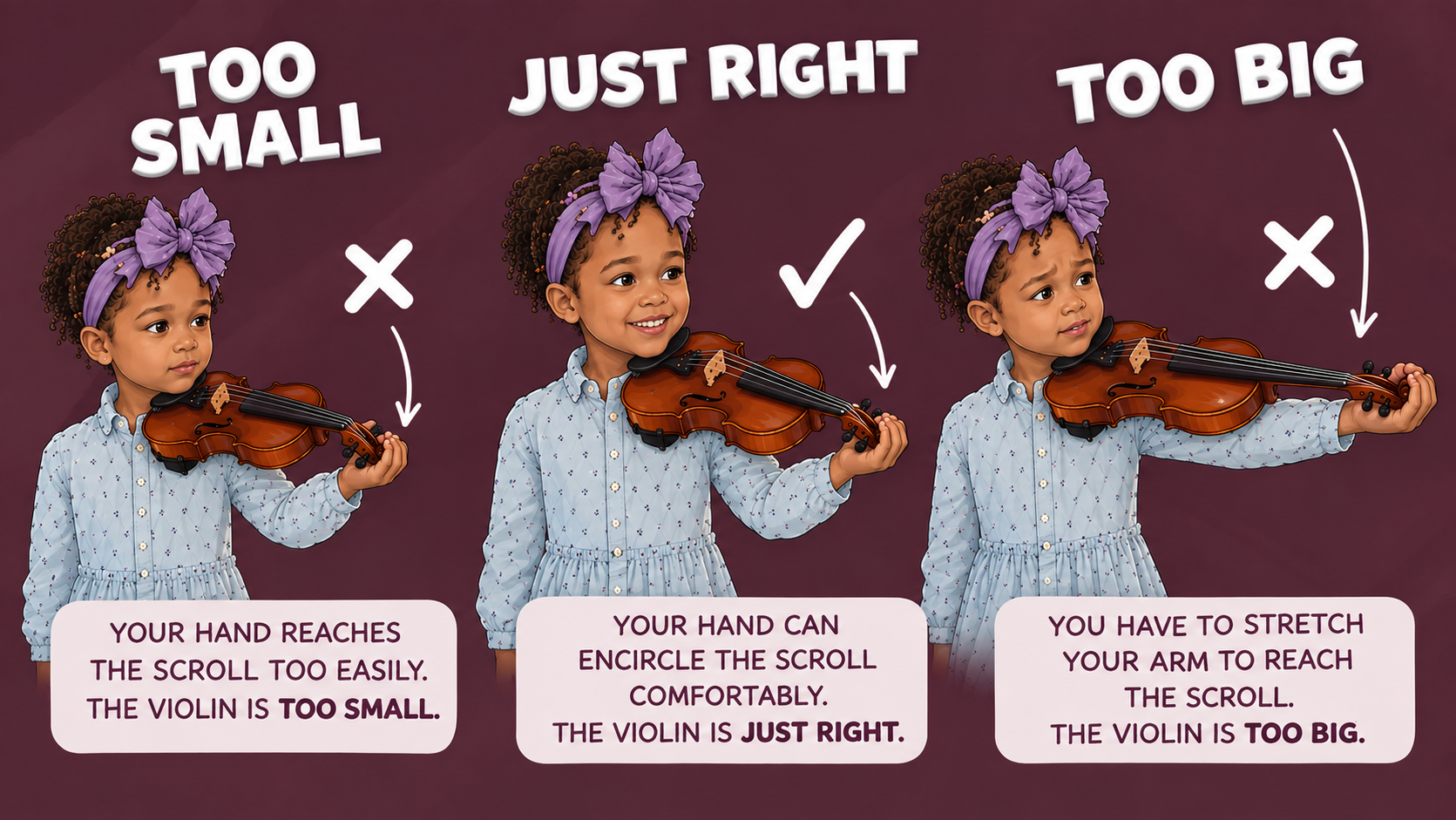
Because sizing doesn’t map neatly to age; every child grows differently, the best way to find the right fit is to visit a violin shop and try a few. A well-fitting violin lets you stretch your left arm until your hand encircles the scroll completely while holding the instrument in playing position, with your arm slightly flexed so it doesn’t feel tense.
* If the hand does not cover the scroll, the violin is too big.
* If the arm is too bent, the violin is too small

2. Materials, What is your violin made of?
or beginners, I always recommend starting with a student violin. These instruments are built from simple woods and are wonderfully durable, perfect for when you’re still learning how to hold and handle an instrument.
Violins are typically built from:
- Solid spruce for the top
- Maple for the back and sides
- Ebony for the fingerboard, pegs, and chinrest
Simpler, more affordable violins use plywood for the top, back, and sides, and a blackened hardwood (rather than ebony) for the fingerboard, pegs, and chinrest. Wood quality varies widely and has a real impact on both price and sound, so it’s worth knowing what your violin is made of before you buy.
Solid wood and real ebony sound and perform better, but they also cost more than laminated and dyed alternatives, so the right choice ultimately comes down to your budget.
3. Check the details
The difference in quality between violins often comes down to construction. Here’s what to check before you buy:
- Fingerboard angle, check that it’s set at the correct incline.
- Overall assembly, look closely at how the whole body has been put together; it should be precise and clean.
- Pegs, they shouldn’t be so long that they poke out the other side of the peg box, but they should still fit snugly.
- Fine tuners, test that they turn smoothly and aren’t stuck.
4. The bow
The bow matters more than people expect, cheap violins often come with genuinely poor-quality bows. A few quick checks will tell you if yours is functional:
- Look at the hair at the tip and frog, it should lie flat and tidy, not bunched together.
- Check that the stick has a gentle curve toward the hair.
- Make sure the screw turns smoothly and creates real tension in the hair.
5. The Luthier
A violin is a work of art, and luthiers are the artists who make it.
Today, many beginner violins are mass-produced in factories at low cost, and that’s often what new players end up with. But a little love from a skilled craftsperson makes all the difference in the world. If you buy your violin from a real violin shop, or bring it to a luthier rather than ordering online, they’ll check that everything is properly in place: setting up the bridge, smoothing the pegs, and checking the sound post. It’s a small step, but it’s exactly the kind of thing that turns “an instrument” into “your instrument.” It’s what I personally recommend to all my students.
That’s it, good luck! I hope this helps you find a violin you’ll fall in love with.
And once you’ve got your violin in hand? That’s when the real adventure starts. If you’re looking for a teacher to guide you through those first notes, I’d love to have you in my lessons. Whether you’re a total beginner or picking the instrument back up after years away. Get in touch and let’s make some music together. 🎻