
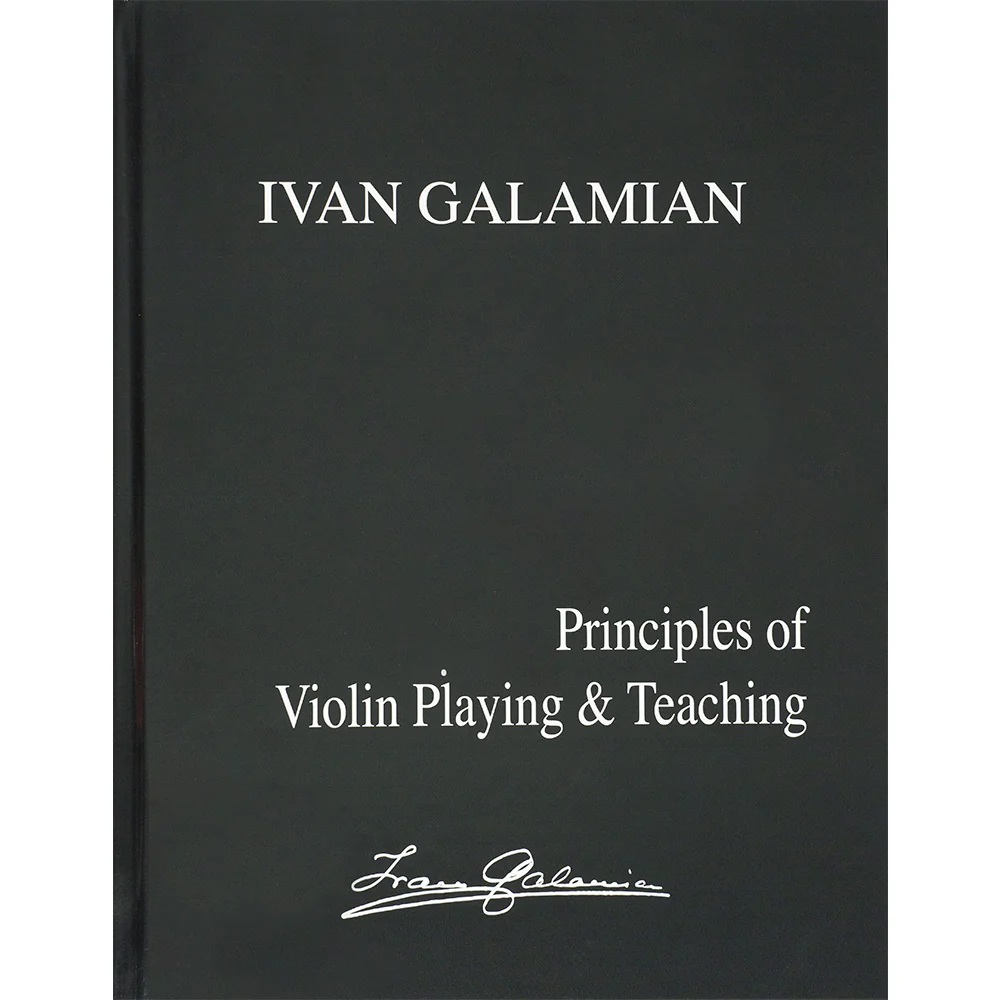
“Nothing is more precious to an instrumentalist than the ability to work efficiently, to know how to achieve the maximum positive results in the shortest possible time.” — Ivan Galamian
Developing good practice habits is essential if we want to make progress in any learning process. It is during our individual practice that real learning takes place: when we analyse, absorb and internalise the concepts introduced by our teacher.
In music, and particularly when learning to play an instrument, these concepts need to remain flexible. This is especially true when we talk about violin technique. A good teacher is someone who guides their students through a process of discovery, allowing them to find their own best version of themselves, one that responds to their physical characteristics as well as their personal interpretation of music.
Many people mistakenly believe that there is one perfectly defined technique for playing the violin, and they set out to find a teacher who will share this long-awaited secret to perfection. However, that secret does not exist.
Every person is different, and therefore each individual’s approach to the violin will be unique. This does not mean that we can do without a mentor or teacher. Rather, the teacher’s role is to guide you through this discovery: to show you the way, while allowing you to make your own decisions and adapt them to your personal circumstances.
Every violinist is a different universe, and ultimately, what works best is whatever feels natural, comfortable and effective for each individual.
A consistent and efficient approach to personal practice is the key to achieving results and reaching our own goals. During this process of self-learning, each violinist becomes the judge of their own performance. Developing good judgement is essential if we are to work, correct and guide our own progress effectively.
In this article, I would like to share my interpretation of three of Ivan Galamian’s key ideas for developing an effective approach to violin practice.
1. Concentration during practice
To develop good violin technique, we need to have a strong mental awareness and control of our physical movements.
It is very common to see students repeating a passage mechanically in the hope that their fingers will eventually memorise it. However, after a number of repetitions, the process can become automatic, relying almost entirely on muscle memory, without any real awareness or judgement of the movements involved.
When this happens, we can easily overlook mistakes and repeat them again and again without even noticing. Even more importantly, if an automatic movement happens to be performed perfectly, but we are not consciously aware of it, we may not be able to reproduce it later in a different passage where the same movements could be useful.
We may not even recognise that we need to use the same muscles or movements, because there is a complete disconnect between the mind and the muscles involved in producing the desired sound. As a result, our practice may only help us with that particular passage, rather than teaching us a skill that can be applied elsewhere.
Developing awareness and mental control of our physical movements allows us to understand how our body works in relation to the instrument. In this way, we can discover and internalise the most effective way of producing the result we want.
Conscious practice should focus on learning to master violin technique itself, rather than simply learning one particular passage. It is a much more efficient use of our time because, in the end, we achieve both things: we master the passage we are working on, and we learn how we managed to master it, knowledge that can then be applied in many other situations.
Routine, mechanical practice without awareness is inefficient. It is an investment of time and effort that ultimately makes little sense.
Our practice should last only for as long as our minds are able to remain focused and concentrated. A tired mind does not pay attention, and therefore it does not learn effectively.
As we have already said, everyone is different. The goal, then, is to develop an ideal practice routine for yourself. Some people may be able to maintain their concentration for a longer period once a day, while others may prefer several shorter practice sessions throughout the day.
There is no need to be overly rigid or obsessed with routine. What matters is learning to listen carefully to the needs of your body and mind, and responding to them with commitment and dedication so that you can get the best possible results from the time you invest.
2. Setting practice goals
Defining long-, medium- and short-term goals is important because it gives structure to our practice. It also gives us a way of evaluating whether our practice methods are producing the results we expect. If they are not, we can analyse what is not working and make changes before too much time is lost.
Short-term goals might be the objectives for our daily practice: What do I want to achieve today?
Medium-term goals could be monthly, while long-term goals might cover six months or a year. All of these goals should be connected. In other words, our short-term goals should help us achieve our medium-term goals, which in turn should lead us towards our long-term goals.
Setting these goals intelligently helps us maintain a conscious approach to our practice and understand the needs that arise along the way, allowing us to address them efficiently.
Practice time should also be distributed appropriately so that we can work on the fundamental aspects of learning the violin. Maestro Galamian divides practice into three different periods:
The construction period
This period is dedicated to building the foundations of our technique, overcoming technical difficulties and generally improving our practical command of the instrument.
This is when we work on scales, arpeggios and technical studies.
As a general guideline, we should move from simple to complex, always progressing through very small steps that allow the mind to understand and control the actions involved in achieving a particular goal.
The idea is always to solve one problem before moving on to the next — rather like building a staircase. Each step needs to be constructed properly before we can climb to the next one.
If one of our steps is weak or badly built, sooner or later we will fall, and inevitably we will have to go back and rebuild it if we want to reach the top.
The interpretation period
During this period, we work primarily on musical expression.
How can we put the technical resources we developed during the construction period at the service of our own musical and interpretative ideas?
How can we organise all the expressive movements within a piece of music so that they come together to tell a convincing and coherent story, appropriate to the moment and the style?
The key is to achieve a perfect balance between construction and interpretation. The relationship between these two aspects is what makes the difference in a performer.
The process is about taking a piece of music apart in order to understand and technically master it, and then putting it back together so that we can bring the music to life through our own interpretative ideas.
The performance period
How many times have we found ourselves in front of an audience or a jury feeling nervous and insecure?
Our minds need to be prepared for the concert environment, and this is something that also requires time and effort.
During our individual practice, we should dedicate some time to developing this period. We can begin by playing the entire piece from beginning to end while placing ourselves mentally in a concert situation, imagining that an audience is sitting in front of us.
Although this may seem like a simple task, it is important to give it the attention it deserves.
We need to resist the temptation to stop every time we make a mistake, whether it is small or significant. If we develop the habit of stopping whenever something goes wrong, our response in a concert situation is likely to be exactly the same.
Playing a piece from beginning to end and continuing regardless of the mistakes or difficulties that arise, without allowing them to affect the quality and continuity of the performance, is much harder than it might seem. It requires a deep level of awareness and concentration.
This type of practice also helps us visualise the piece as a complete performance and develop a sense of continuity.
Of course, once we have finished playing, it is still important to remember what went wrong so that we can go back and work on it afterwards.
3. Developing a critical ear
As I mentioned at the beginning of this article, real learning takes place during individual practice. This is where each of us must become our own judge when assessing the quality of our work, whatever type of practice we are focusing on at the time.
To do this, we need to develop a critical ear, one that can monitor what we are doing and help us determine the best way to correct difficulties.
This critical ear needs to be objective. Under no circumstances should it be influenced by what we want to hear.
Sometimes we convince ourselves that what we are hearing is good enough when, in reality, it is not. Perhaps we allow self-compassion to cloud our judgement.
Self-compassion is certainly something we should have in our lives. But in this particular situation, if our genuine goal is to become a good violinist, we need to put it to one side. When it comes to evaluating the quality of our individual practice, we need to be as objective as possible.
Recording yourself is an excellent way to refine your critical ear.
Have you ever recorded yourself and then felt incredibly uncomfortable listening back to it? Did you sound different from the way you thought you sounded?
Let me tell you something: your critical ear probably wasn’t being objective enough to tell you what was really happening while you were practising.
Most people are afraid to record themselves precisely because of that uncomfortable feeling that comes from realising that what they are playing doesn’t sound the way they imagined it would.
If this has happened to you, don’t turn away from the camera. Move towards it, because it can become one of your greatest allies in improving your playing.
Little by little, you will be able to identify and correct the things that weren’t working. Recording yourself makes you aware of mistakes that you may have been overlooking.
Over time, you will also become more comfortable listening to yourself because your critical ear will become increasingly objective. What you hear during your daily practice will gradually become more consistent with what you hear when you listen back to a recording.
Listening to ourselves in the same way that an audience would listen to us is one of the most powerful ways to identify what needs to change and establish clear practice goals that will help us improve.
The goal isn’t simply to practise more. It is to practise with greater awareness, intention and understanding.